 At the Table
Four Minutes Under a Lid, Twelve Plants, and Not One Amount on the Tin
A loose-leaf tea from India asks for something no bottle on the shelf asks for: you have to make it. I went through the four steps on its tin and wrote down what each one can tell you.

This is a paid advertisement. Sponsored by Herbkart Commerce Inc.

Most things sold for an older man's memory ask him to swallow something and get on with his day.
This one asks for a kettle, a teaspoon, a lid and three or four minutes at the table.
It is a 100-gram tin of loose green tea blended with eleven Indian herbs, roots and spices, packed in Kolkata and sold from Chennai.
The tin prints twelve names and not one amount.
So this page does the only honest thing a reader can do with a tin like that.
It takes the four steps printed on its side one at a time, and at each step it writes down what you can know and what you cannot.
Norman Pyle is the pen name of this desk.
Everything on this page about the tin comes from the seller's own product page and its photographs of the tin, and from the seller's contact, shipping and returns pages, read on September 5 and checked again on September 21, 2026.
There are no customer reviews on this page, because the seller's page has none to quote.
The photographs of people on this page are illustrations, not buyers.
There is a long table in almost every kitchen I have ever liked.
It is the table where the mail gets opened, the crossword gets half-done and the afternoon moves more slowly than anywhere else in the house.
My grandmother had one, scrubbed pale down the middle, with a kettle that lived on the stove behind it.
Nothing important was ever decided at that table, and everything that mattered got talked about there.
That table is where this tin belongs, if it belongs anywhere.
Not in a medicine cabinet, not in a car door, not in a coat pocket.
It is the only product I have looked at this year that cannot simply be taken. It has to be made.
Everything else on the shelf marked for memory and focus arrives as a measured thing.
A spray has its sprays, a liquid has its milliliters, a powder has its scoop, and the label tells you what each one weighs.
A tin of loose leaf works the other way round.
You measure it yourself, with your own spoon, into your own cup.
And the tin never tells you what that spoonful weighs, or what is in it by the gram.
That is not a small difference, and it is the whole subject of this page.
It changes what a buyer can know.
It changes what anybody can honestly promise him.
So here is the honest shape of it, up front, so nobody has to read nine thousand words to find out where this lands.
The tin lists twelve ingredients: green tea first, then ginkgo, gotu kola, amla, rosemary, brahmi, aloe vera, holy basil, ginger, ashwagandha, cinnamon and turmeric.
It gives no amount for any of them, and no weight for the teaspoon it asks you to use.
Green tea is first on the list, so it is very likely most of what is in the tin.
That means the cup carries caffeine, in an amount the tin does not print.
Two of the other eleven names have trials in adults your age that I am willing to put in front of you.
Both of those trials used concentrated extracts, weighed to the milligram and swallowed, not leaves steeped in hot water.
One name, rosemary, has a small study that used plain dried leaf at close to a kitchen amount.
It is the nearest thing to a cup of tea in the whole research file.
Five of the twelve names have nothing I could cite at all.
I will say so when we get to them, rather than borrow a study about something else.
What you can count on is simpler: a hot cup of green tea with spice in it, four minutes of waiting at a table, and a habit you can keep at the same hour every day.
Whether that is worth the price of a tin shipped from India is a question you can answer better than I can.
My job is to make sure you answer it with the right facts in front of you.
What Is Inside the Gold Lid, and Who Put It There
The tin is sold under the name TeaRaja.
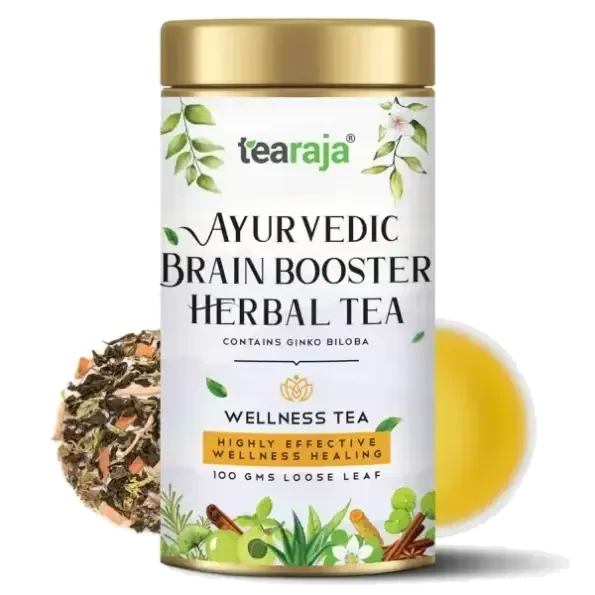
The full name printed on its front is Ayurvedic Brain Booster Herbal Tea.
That is the maker's name for the product, and I will use it only as a name.
It is not a promise this page makes, and nothing in the research below would let me make it.
The front also calls it a wellness tea and says, in small capitals, that it contains ginkgo biloba.
A gold band across the front carries a three-word slogan I will not repeat, because nothing I read supports it.
The back of the tin names who made it.
It was packed and marketed by a company called FY Wellness Private Limited, at an address on Kailash Bose Street in Kolkata.
The company that sells it to you is a different one.
It is Herbkart Commerce Inc., an online shop in Anna Nagar East, in Chennai, on the other side of India from Kolkata.
Herbkart sells its own products and other people's, and says so on its site.
Its contact page gives a WhatsApp and Signal number in India, +91 85969-79989, and its privacy policy gives an email address, talk@herbkart.com.
That is who you would be dealing with: a shop in Chennai that answers on WhatsApp.
I will come back to what that means for shipping and returns, because it matters more than anything on the ingredient list.
One more fact about the tin before we open it.
It carries the logo of India's food regulator, which means it is sold there as a food, a herbal tea, and not as a medicine or a supplement.
In the United States it arrives as an imported food.
Nobody at the Food and Drug Administration has reviewed what it says about itself, and the tin carries the standard statement that it is not meant for any medical condition.
What "Ayurvedic" Means on the Front of a Tin
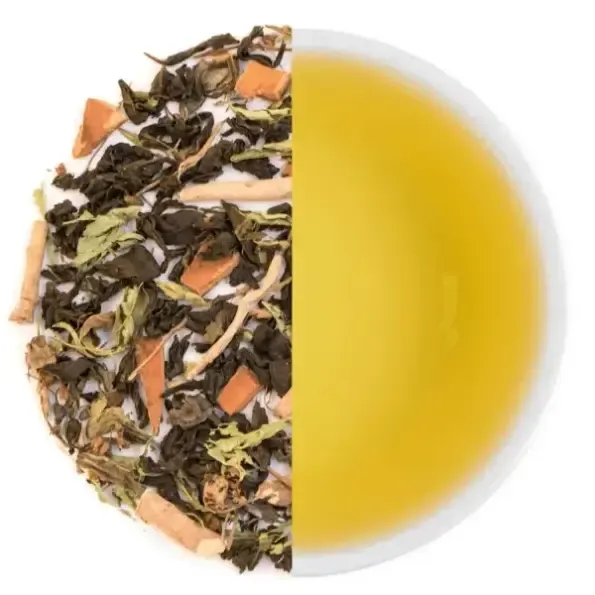
The first word on the front of the tin is "Ayurvedic," and it is worth a few lines, because it tells you where the recipe comes from.
Ayurveda is the traditional system of health practice of India, thousands of years old, and it is still part of ordinary household life there.
In that tradition, plants are rarely taken one at a time.
They are combined, cooked into food, stirred into milk, pressed into pastes and brewed as teas.
A blend of a dozen plants in one cup is not a strange thing at all in that kitchen.
It is closer to a family recipe than to a formula.
Several of the names on this tin, amla, brahmi, ashwagandha, holy basil, turmeric and ginger, are among the most familiar plants in that household tradition.
Put them with green tea and cinnamon and you have something many Indian kitchens would recognize at a glance.
Tradition tells you how long people have used a plant, and how they used it.
It does not tell you what a given amount does in a given man, and it was never meant to.
That is a different question, with a different kind of answer.
It is answered by trials, with weighed amounts and a placebo group, and most of this page is about those trials.
Read "Ayurvedic" on the tin as a statement about where the recipe comes from, not about what the cup will do.
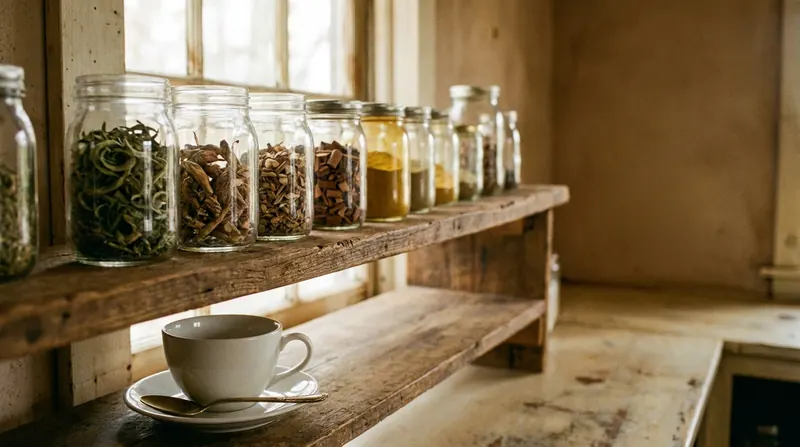
Four Steps, Printed on the Side of the Tin
The seller's product page does not tell you how to make this tea.
It says only to steep it as directed and to enjoy it daily, which directs you to nothing.
The directions are on the tin itself, on a panel headed "How to prepare."
I read them from the seller's own photograph of that panel, and they are short enough to write out in full.
Step one: add 1 tsp tea to one cup of boiled water.
Step two: cover it with a lid.
Step three: steep for 3-4 minutes.
Step four: strain and drink.
And then, as the tin puts it, "A perfect cup of tea is ready."
That is the entire method.
No temperature beyond boiled, no size of cup, no number of cups a day, no time of day.
The same panel adds two notes about keeping the tin, and a line saying the tea is best within twenty-four months of packing.
I will get to the keeping notes last, because one of them argues with the other.
Four steps, then: a teaspoon, a lid, three to four minutes, a strainer.
Each one raises a question.
Each question has either an answer you can check or an honest blank, and I will tell you which is which.
Step One: A Teaspoon Nobody Has Weighed
The first step is the one that decides everything after it.
"Add 1 tsp tea," the tin says, and a teaspoon is the only measure you are ever given.
A teaspoon is a volume, not a weight.
Loose leaf is a jumble of flat leaves, curled leaves, chips of bark and sticks of root.
A spoonful of it can be heaped or level, packed or loose.
Two men following the same instruction can put quite different amounts in their cups without either of them doing anything wrong.
The tin does not say what a level teaspoon of this blend weighs.
The seller's page does not say either, and I found no figure for it anywhere I looked.
The only official number I have for a spoonful of a dried herb comes from the United States Department of Agriculture's food database.
It lists a teaspoon of ground sage at seven-tenths of a gram. [1]
Ground sage is a fine powder, and this blend is not, so I am not handing you that number as the weight of your spoonful.
I am handing it to you as a sense of scale: a teaspoon of dried plant is measured in single grams, not in tens of grams.
Hold on to that scale, because every trial you will read about below was measured in milligrams of one ingredient, and your teaspoon holds twelve.
Here is the arithmetic the tin lets you do, and it is the only arithmetic it lets you do.
One hundred grams in the tin, divided by whatever your teaspoon weighs.
If your spoonful comes to two grams, the tin makes about fifty cups.
If it comes to three, about thirty-three.
Somewhere between a month and a month and a half of one cup a day, depending on your spoon and your hand.
That is a reasonable thing to know before you order a tin from the other side of the world.
Now the harder part.
Inside that spoonful are twelve different plants, and the tin prints them in a list with no figure beside any of them.
In most places, an ingredient list is printed in order of weight, heaviest first.
If this one follows that custom, the green tea is the largest share and the turmeric at the end is the smallest.
But a custom is not a figure.
I cannot tell you whether the green tea is nine-tenths of the spoon or half of it, and neither can anyone outside the company that packed it.
A spoonful is where the tin stops telling you things and you start guessing.
The seller's own listing adds a small wrinkle.
Its title names four herbs, ginkgo, gotu kola, amla and aloe vera, and its table of details gives the key ingredients as ginkgo and brahmi.
Neither of those matches the order on the tin, where green tea comes first and ginkgo second.
It is the kind of mismatch that happens when a listing and a label are written by different people.
It is also one more reason to trust the tin over the page whenever the two disagree.
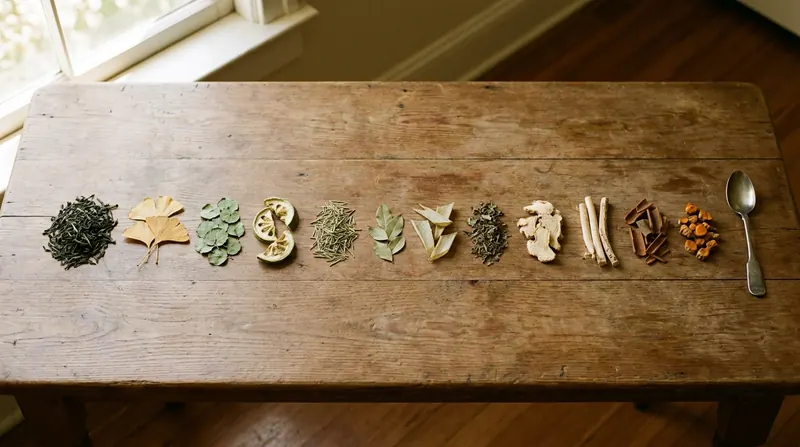
Twelve Names, in the Order the Tin Prints Them
Here is the list from the tin, written out in full, because nothing else on this page makes sense without it.
I have changed nothing and left nothing out.
First, organic green tea, the leaf of the tea plant.
Second, ginkgo biloba leaf, spelled one way on the front of the tin and another way on the back.
Third, gotu kola.
Fourth, amla, the Indian gooseberry.
Fifth, rosemary.
Sixth, brahmi, also called bacopa.
Seventh, aloe vera.
Eighth, holy basil, called tulsi in India.
Ninth, ginger root.
Tenth, ashwagandha, sometimes called Indian ginseng.
Eleventh, cinnamon.
Twelfth and last, turmeric.
None of the twelve has an amount beside it.
The panel's nutrition box says only that protein, fat, carbohydrate and energy are present in traces per hundred grams, which is what you would expect of dried leaves.
Twelve names, one spoon, and no figures: that is the panel.
What follows takes the names one at a time, in the tin's order, and puts each beside the best research I could find on it in people.
Wherever a trial used an extract, I will say so, because an extract swallowed in a measured amount and a leaf steeped in water are different things, and that difference is the heart of this page.
Green Tea Comes First, and It Is Most of the Cup
Green tea is the leaf of the tea plant, dried before it has a chance to darken.
Green, black and oolong tea all come from that one plant; only the handling differs. [2]
It is the first name on this tin, and it is almost certainly the backbone of the blend.
Look at the seller's photograph of the dry leaf and most of what you see is dark, twisted tea.
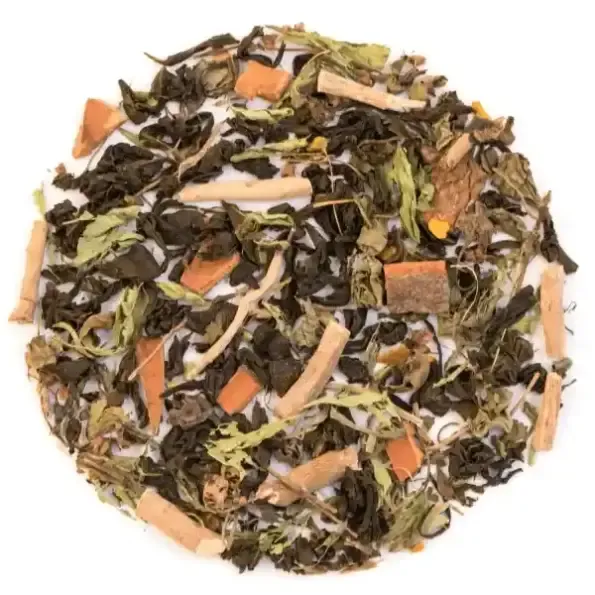
Green tea contains caffeine. [2]
The tin does not say how much a cup of this blend carries.
I will not guess a number for it.
A guess printed on a page has a way of turning into a fact in a reader's head.
What I can give you is the frame.
The Food and Drug Administration cites four hundred milligrams of caffeine a day, about two to three twelve-ounce cups of brewed coffee, as an amount not generally associated with negative effects in most healthy adults. [3]
The same agency notes that too much can bring a faster heartbeat, jitters, an upset stomach, headaches and a poor night. [3]
Europe's food authority reached a similar place, putting single doses up to two hundred milligrams and daily intakes up to four hundred inside the range that raises no concerns for healthy adults. [4]
A cup of green tea is not going to take a man anywhere near those limits on its own.
But it is caffeine, it adds to whatever coffee you already drink, and it belongs in the morning or early afternoon rather than after supper.
That single fact, that this is a caffeinated cup, is the most useful thing to know about the whole tin, and the tin does not print it.
Tea leaf also carries an amino acid called L-theanine, and it is the part of green tea researchers have looked at most closely for attention.
In a study of Japanese men and women aged fifty to sixty-nine, a single dose of L-theanine was followed by a faster reaction time on an attention task and fewer mistakes on a working-memory task. [5]
The published summary of that study does not give the dose or the number of people.
Its authors came from a tea company, and I pass both facts on because you would want them if you were reading the study yourself.
A second trial is clearer about its numbers.
Thirty healthy adults with an average age of forty-eight took two hundred milligrams of L-theanine a day for four weeks. [6]
Their scores on word fluency and on planning tasks improved, and against placebo the word-fluency gain showed up mostly in the half who started lower.
Two of that trial's authors worked for the company that supplied the L-theanine.
Two hundred milligrams a day, taken as a tablet, is a measured dose.
That is exactly what a cup of loose leaf is not.
The best-known study of tea's pairing is small and specific.
Twenty-seven volunteers took fifty milligrams of caffeine with one hundred milligrams of L-theanine, and an hour later they switched between attention tasks faster and more accurately than on placebo. [7]
The volunteers' ages are not in the published summary, the authors worked for a tea maker, and it was a single dose.
It is also the reason tea keeps turning up in conversations about attention, because the leaf carries both halves of that pair.
What nobody has measured is how much of either half comes out of a teaspoon of this blend in four minutes. The tin does not say, the seller does not say, and I will not pretend.
One more green tea study, because it comes closest to the age of the men reading this.
Japanese adults aged fifty to sixty-nine who felt their memory had slipped took decaffeinated green tea catechins, 336 milligrams at a time. [8]
After one dose they made fewer errors on an attention test, and after twelve weeks they answered a working-memory task faster.
Catechins are the bitter compounds of green tea, and this was a concentrated, caffeine-free extract taken as a measured amount.
The study summary does not state how many people took part.
I note that for the same reason I noted the others: a number you cannot find is part of the finding.
The National Institutes of Health adds two cautions about green tea that belong on any honest page. [2]
Harm to the organ that processes what you swallow has been reported in some people, mostly with concentrated green tea extracts in tablet or capsule form rather than with the drink.
The same page notes that green tea can make some things people take daily work less well.
That is a question for a pharmacist, not for a tin.
If you take anything daily, carry the tin to your pharmacist before it becomes a daily cup.

Ginkgo, Spelled Two Ways on the Same Tin
Ginkgo is the second name on the tin, and the tin is so keen on it that it prints it on the front.
It prints it wrong there, as "Ginko Biloba," and right on the back, as "Ginkgo Biloba."
That is a small thing, a typesetter's slip, and I would not mention it if it were anywhere else.
It is on the front of the tin, under the name, as the one ingredient the maker chose to show you.
So here is that front, and the tin it is printed on, since everything so far has come from its side and its back.
Ginkgo is the fan-leaved tree you have seen along city streets, a species so old it is called a living fossil.
Its dried leaf is what is in this tea, which is a different thing from the standardized leaf extract used in the research.
The research on that extract is large.
The largest trial of all is the one a man your age most needs to hear about, and it found nothing.
The largest ginkgo trial ever run followed 3,069 adults aged seventy-two to ninety-six for a median of six years and one month.
They took a standardized ginkgo extract, 120 milligrams twice a day, or a placebo.
Their memory, attention and language scores slipped at the same rate in both groups. [9]
That is 240 milligrams of concentrated extract a day, for six years, in more than three thousand people.
A pinch of dried ginkgo leaf, sharing a teaspoon with eleven other plants, is a different order of thing altogether.
I cannot tell you how much ginkgo is in your spoon, but I can tell you it is not 240 milligrams of that extract.
There is a smaller trial that went the other way, and it belongs in the file too.
Ninety-three healthy adults aged fifty-five to seventy-nine took 120 milligrams of ginkgo extract a day for twelve weeks. [10]
They did better than placebo on one kind of longer-term memory task.
They did no better on any of the other measures in the trial.
One positive result among many measures, in a trial of ninety-three people.
I report it because it exists, and I weigh it against the six-year trial of three thousand, which is how anyone reading both should weigh them.
The National Institutes of Health's center for complementary health sums up the whole file in one sentence.
There is no conclusive evidence that ginkgo is helpful for any health condition. [11]
That is the government's own summary, and it is more careful than the front of this tin.
Ginkgo also carries a caution worth knowing: it may add to bleeding in people who take anything that thins the blood.
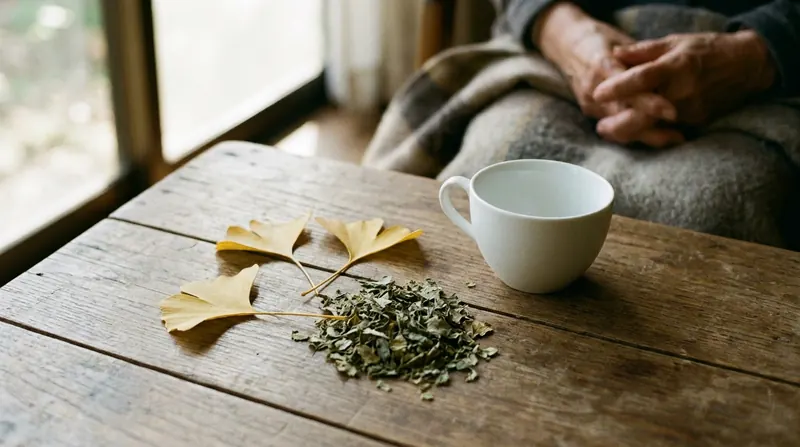
Gotu Kola and Brahmi, Two Plants That Sometimes Share a Name
The third name on the tin is gotu kola, and the sixth is brahmi.
They are two different plants, and in parts of India the name brahmi is given to both, which is why some blends list the two side by side.
Gotu kola is a small creeping plant with fan-shaped leaves, eaten as a salad green across South and Southeast Asia.
Brahmi, also called bacopa or water hyssop, is a creeping herb of wet ground and pond edges, with small oblong leaves.
Both have long places in Ayurvedic practice, and both have been studied in people.
Their files could hardly be more different.
Gotu kola first.
In a small two-month trial of twenty-eight healthy older adults, the highest dose of a gotu kola extract, 750 milligrams a day, was followed by better working-memory scores and a higher sense of alertness. [12]
Then a review pooled the randomized trials together and found no effect on test scores overall. [13]
It did find that people felt more alert, which is a real finding about how people feel, and a different thing from how they scored.
Gotu kola, then: one small trial at 750 milligrams of extract a day, and a pooled review that found nothing on the tests themselves.
Brahmi is the name on this tin with the most consistent research in men your age, and I want to give it its due.
Fifty-four healthy adults aged sixty-five and over took 300 milligrams a day of a standardized extract for twelve weeks, and forty-eight of them finished. [14]
They recalled more words after a delay and did better at ignoring distractions than the placebo group.
They did no better on divided attention or on holding things in mind for a moment.
A second trial, of ninety-eight healthy adults over fifty-five, used the same 300 milligrams a day for the same twelve weeks. [15]
Verbal learning and delayed recall came out better than placebo, and the other measures did not.
And a pooled analysis of nine randomized trials, 518 people between them, found faster performance on two tests of attention speed, by milliseconds. [16]
The authors themselves asked for a large, well-designed trial before anyone drew firm conclusions.
Three hundred milligrams a day, of an extract standardized to a stated strength, for twelve weeks.
That is the figure the brahmi research stands on, and it is a figure you will not find anywhere on this tin.
Brahmi is sixth of twelve in a teaspoon, and the tin names the plant, not an extract.
Whatever share of the spoon it takes, four minutes in hot water does not turn it into 300 milligrams of a standardized extract.
One thing the brahmi trials tell you that the tin does not.
Their commonest complaints were digestive: stomach upset, looser stools, cramps and nausea. [15]
That is not a reason to fear a cup of tea. It is a reason to notice your stomach in the first week of any new daily habit.

Rosemary, and the One Study Here That Used a Kitchen Amount
Rosemary is the fifth name on the tin.
It is the one I would point to if a man asked me which part of this research looks most like a cup of tea.
It is the herb from the Sunday roast, a small evergreen shrub of the Mediterranean coast.
It has been tied to memory in folklore since ancient Greece, and it still turns up at weddings and funerals as a sign of remembrance.
Folklore is not evidence, but one small study took the old idea seriously, in the right people.
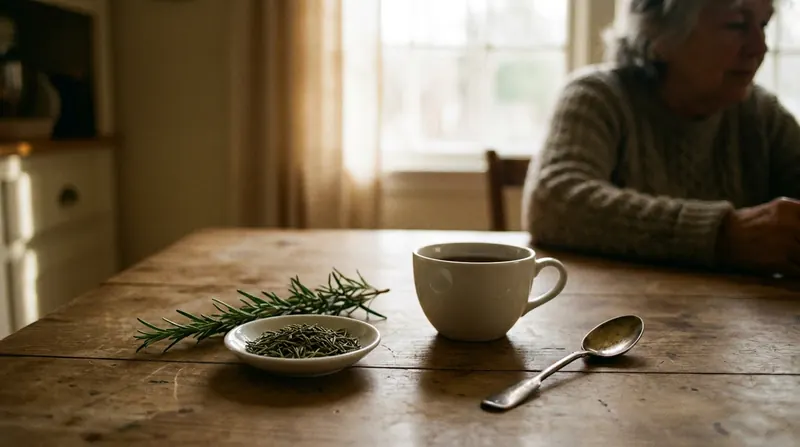
Twenty-eight adults with an average age of seventy-five took single doses of plain dried rosemary leaf, each person trying each dose on a different day. [17]
At 750 milligrams, close to what a cook might use, their speed of memory was faster than on placebo.
At 6,000 milligrams, eight times as much, it was slower. [17]
Plain dried leaf, not an extract, at close to a kitchen amount, in adults with an average age of seventy-five: nothing else in this tin's research file comes that close to the cup.
Now the honest limits, because they are large.
It was a small study of single doses, and the effect was on speed, not on how much people remembered.
And 750 milligrams of rosemary is three-quarters of a gram.
If your whole teaspoon of this blend weighs something like two grams, rosemary, fifth of twelve, is almost certainly a small part of that.
The study's other finding is the one I would underline.
More was not better; the large dose went the wrong way.
With herbs, a kitchen amount and an extract amount are different animals, and more is not automatically better.
Ashwagandha and Turmeric: Roots in the Cup, Extracts in the Trials
Two of the roots in this blend have trials behind them.
Both trials used something very unlike a chip of root in hot water.
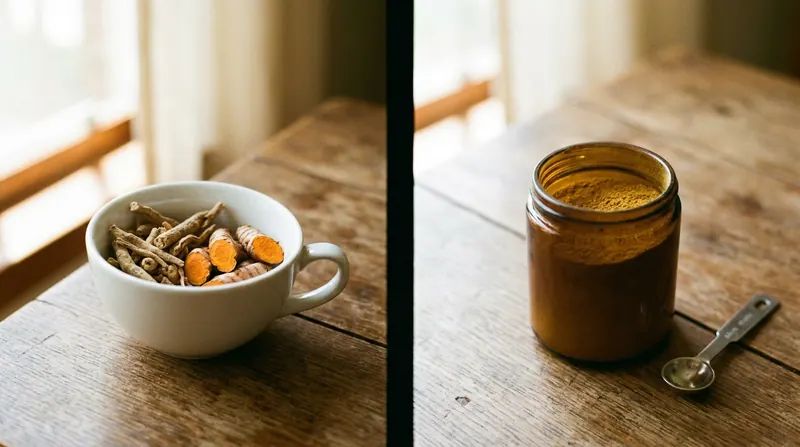
Ashwagandha is tenth on the tin.
It is a short shrub of the nightshade family, and its root has been used in Ayurvedic practice for more than three thousand years, usually as a powder stirred into warm milk.
In a ninety-day trial of 125 healthy adults aged twenty to fifty-five who described themselves as under strain, 300 milligrams a day of a slow-release root extract was followed by better memory and focus scores than placebo. [18]
Twenty to fifty-five, not sixty-five, and a concentrated extract made to release slowly.
A second study was run in adults with an average age of twenty-three.
They took 225 milligrams a day of a special form of root-and-leaf extract and scored better than placebo on some measures of recall and reaction time. [19]
Average age twenty-three is a study about students.
I will not lend it to a man of sixty-six deciding whether to order a tin of tea.
Ashwagandha carries a caution the tin does not print.
Reference texts describe rare cases of harm to the organ that processes what you swallow with ashwagandha products, and it is not for use in pregnancy.
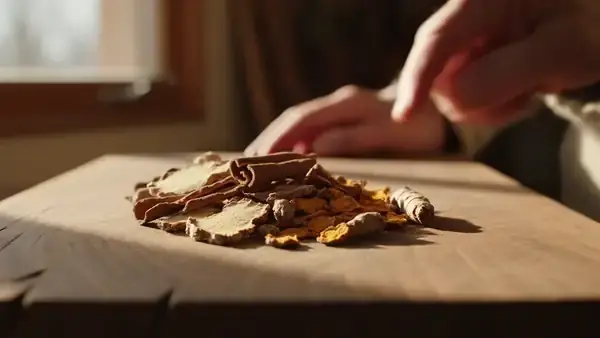
Turmeric is last on the tin: the yellow root that colors curry.
The compound researchers care about in it is curcumin, and the trial people point to ran for eighteen months. [20]
Forty adults aged fifty-one to eighty-four took ninety milligrams of curcumin twice a day, in a patented form made to be absorbed far better than the spice.
They scored better on verbal memory, visual memory and attention than the placebo group, twenty-one people against nineteen. [20]
The National Institutes of Health's center for complementary health says plainly that we do not know enough to conclude whether turmeric or curcumin is beneficial for any health purpose. [21]
It also notes that harm to the organ that processes what you swallow has been reported in some people who took the highly absorbable forms.
A pinch of dried turmeric root in a cup of tea is the kitchen kind, not the studied kind.
Five Names With Nothing I Could Cite
That leaves five names, and I can deal with them quickly.
I have nothing to cite for any of them on memory or attention, and I would rather tell you that than borrow a study about something else.
Amla, the Indian gooseberry, is a very sour pale-green fruit and one of the richest food sources of vitamin C.
It is eaten pickled and candied across India and is a staple of Ayurvedic tonic mixtures, and I found no trial linking it to memory or attention in healthy adults.
Aloe vera is the cactus-like plant whose clear inner gel is familiar from the bathroom shelf.
The tin does not say which part of the leaf is in the blend, and I found nothing linking aloe to memory or attention.
Holy basil, called tulsi, is a clove-scented relative of kitchen basil, grown in Indian courtyards and brewed on its own as a tea.
I found no good study in people showing it does anything for memory or attention, and it may lower glucose alongside anything taken daily for glucose.
Ginger is the knobbly root in every spice rack and the warming note in Indian chai.
Its research is about the stomach, not about memory, and I will not stretch it to cover something it never looked at.
Cinnamon is the dried inner bark of tropical trees, and it comes in two kinds: Ceylon, and the more common cassia.
The tin does not say which it uses, and that matters for one reason.
Cassia contains a compound called coumarin, and a lot of it over a long time is a concern for the organ that processes what you swallow.
In a pinch of bark in a daily cup, that is not an alarm; it is simply one more question the tin leaves you to ask.
Five of twelve names with nothing to cite. They are in the cup for flavor and tradition, and that is a perfectly good reason to drink a tea.
Step Two: Cover It With a Lid
The second step on the tin is five words long: "Cover it with a lid."
It is the step most people skip, and the tin gives no reason for it.
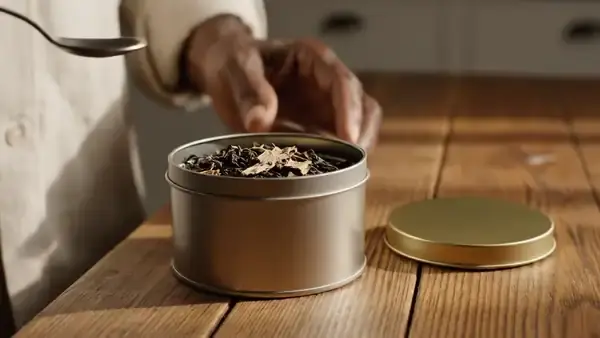
Any cook can give you one.
A covered cup holds its heat, and it holds in the smell of whatever is steeping, which in this blend means cinnamon, ginger, basil and rosemary.
Those are ordinary kitchen facts, and I offer them as that, not as chemistry.
Nobody has measured what this blend gives up to the water with a lid on or with a lid off, and I will not make up a difference.
What the lid does for certain is make you wait.
You cannot see the tea, you cannot poke at it, and you cannot pretend it is ready before it is.
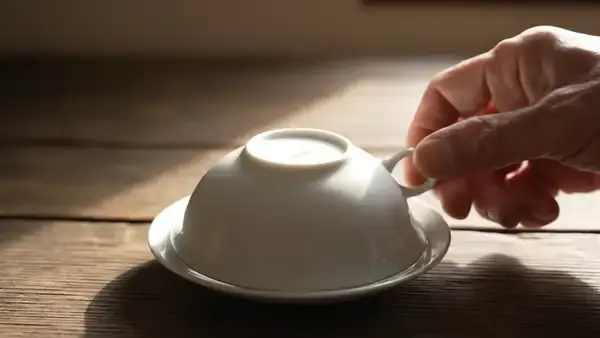
A saucer does the job if your cup has no lid of its own.
So does a small plate, turned upside down, which is what my grandmother used.

Step Three: Three to Four Minutes at the Table
The third step is the one I think this whole product is really about.
"Steep for 3-4 minutes."
Three to four minutes is not long.
It is long enough, though, to notice that it is the only part of the day in which nothing is asked of you except to sit.
You cannot speed it up, and you cannot do it on the move.
The kettle has boiled, the cup is covered, and for four minutes you are a man at a table with his hands empty.
Most products sell you a result. This one, whatever else it does, hands you four minutes.
I want to be careful here, because it would be easy to dress those four minutes up.
I am not going to tell you that four minutes at a table does anything to your memory.
I have no study that says so, and I am not going to invent one.
What I will tell you is how to use those minutes honestly, if you buy this tin.
Make the cup at the same hour every day, in the same cup, with the same level teaspoon.
Then, if you think it is doing something, you are comparing a Tuesday with a Tuesday rather than a good afternoon with a bad one.
Without a fixed hour, every good afternoon looks like the tea and every bad one looks like bad luck.
With one, the tea has to earn its credit against days that are otherwise alike.
And now the part the four minutes cannot do.
The trials in this file all used extracts, made in laboratories, standardized to a stated strength and swallowed in measured milligrams.
A cup of tea is whatever hot water pulls out of a spoonful of leaves in four minutes.
Nobody has measured that for this blend, and nobody can tell you from the outside how close it comes to any of the amounts in the studies above.
That is the most important sentence on this page, so I will put it as plainly as I can: the research on these plants was done with extracts, and this is a tea.
It does not make the tea worse.
It makes it a different thing, and it means the research on the extracts cannot simply be poured into your cup and credited to it.
Step Four: Strain and Drink
The last step is the plainest, and it holds one fact worth noticing.
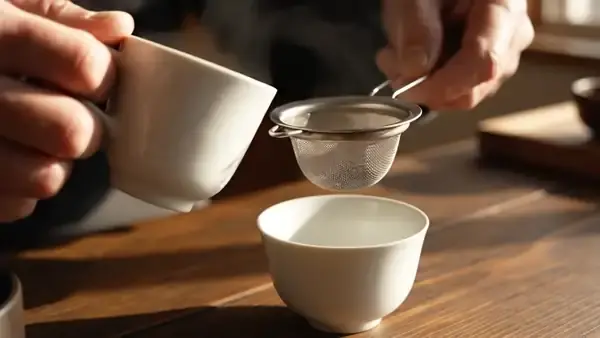
"Strain & drink."
When you strain the cup, most of what was in your teaspoon stays behind in the strainer.
The leaves, the bark chips and the root sticks go in the bin or the compost, and what you drink is the water they sat in.
That is how tea works, and there is nothing wrong with it.
It simply means the question is never how much of each plant went into the cup, but how much of each plant came out.
That second number is the one no tin prints, and for this blend nobody has measured it.
The tin ends its method with a small promise of its own: "A perfect cup of tea is ready."
That is the one line on the panel I am happy to leave alone, because whether the cup is perfect is up to your tongue.
If you want the strainer to do less work, a small mesh infuser in the cup does the same job from the start.
The tin does not mention one, and it does not need to.
Keep It Cool and Dry, and Also in the Refrigerator
The same panel that gives the four steps gives two notes on keeping the tin.
"Always use a dry spoon, store in a cool, dry & hygienic place," it says.
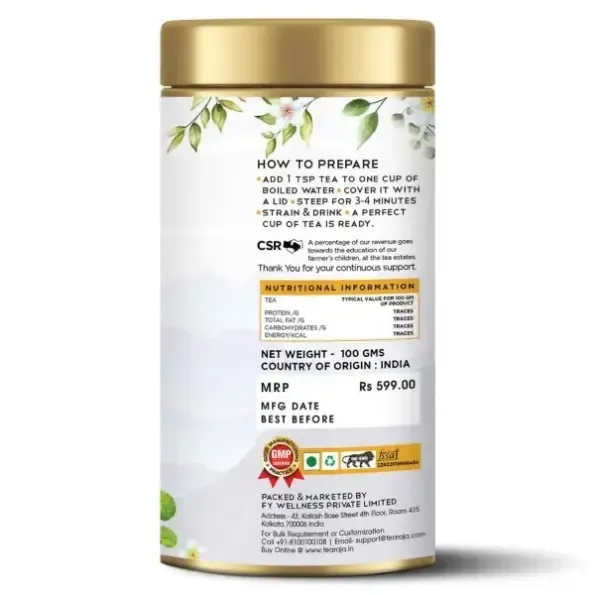
A few words further on, the same panel says: "Store under refrigeration."
Those two do not sit easily together.
A refrigerator is cool, but it is not dry.
A tin taken in and out of one every afternoon gathers a little moisture on the inside each time it warms up with the lid off.
I cannot tell you which of the two the packer meant.
The practical answer is the first one, which is what most people do with loose tea anyway: a cool cupboard, away from the stove, with the lid pressed down.
The panel also asks you to keep the tin away from things with a strong smell, which is good advice for any tea.
It gives a best-before of twenty-four months from the date of packing.
The dry spoon is the note I would underline.
A wet spoon in a tin of dried leaves is how a tin of dried leaves stops being one.
The seller's listing adds two claims that are not on the tin.
It says the tea has no preservatives, and that it is nitrogen-flushed and vacuum-sealed for freshness.
Neither of those is printed on the tin, and I have no way to check either one. I note them as the seller's words, not as facts.

What the Back of the Tin Claims, and Why It Stays There
Every product in this category makes claims on its packaging, and this tin is no exception.
Its back carries a short list of benefits in the maker's own words, and its front carries that gold band.
I have read them all.
I am not going to repeat them on this page as if they were mine.
None of them comes with a study, and none of them says how.
None of them can be backed by the amounts on the panel, because the panel has no amounts.
The seller's listing adds a few lines of its own, each a two- or three-word promise about one of the herbs.
Those stay on the listing too.
A claim printed on a tin is the maker's statement, and it is only as good as what stands behind it.
Behind these, as far as I could find, stands the research you have just read: extracts, measured doses, a handful of small trials, and one very large trial that found nothing.
The same tin does print one thing I will repeat, because it is sensible.
It says the product is not meant for any medical condition, and that you should ask your own health care provider if you have questions about your own situation.
When the small print on a tin is more careful than the big print, believe the small print.
A Parcel From Chennai, and What Happens If It Goes Wrong
Now the part that matters more than anything on the ingredient list, because it is about your money.
This tin is sold by Herbkart Commerce Inc. from Chennai, and it ships to the United States from India.
The seller says standard shipping costs nothing extra, worldwide, with no minimum order.
It also says orders typically leave within one to two days.
Its shipping policy does not give a delivery time to the United States.
I could not find one anywhere on the site, so I cannot give you one either.
It does say that buyers are responsible for any customs and import charges.
And it says that parcels refused or held at customs are the buyer's problem, not the seller's.
Read the returns policy before you order, not after.
It is short, and one sentence in it changes everything.
Here is that sentence, from the seller's own returns policy: "International returns are not accepted."
For a buyer in the United States, that is most of the story.
The policy does allow a claim within thirty days of delivery, but only if the product is wrong, damaged in transit, expired or incomplete.
It asks for an unboxing video, filmed as you open the parcel, as a condition of that claim.
It also says it cannot refund a product whose seal has been opened.
Complaints about the taste or quality of food products, it says, go to the maker rather than to the shop.
And a full refund on cancellation is possible only within twenty-four hours of placing the order.
In plain words: if the tin arrives in good order and you simply do not like the tea, there is no refund.
That is the single most important fact on this page for your wallet.
I do not say that to warn anyone off.
A shop on the other side of the world cannot sensibly take back an opened tin of food, and most tea shops anywhere would say much the same.
I say it so that you order with your eyes open.
If you do order, film the parcel as you open it, check the seal, and keep the order number somewhere you can find it.
The seller's contact page gives a WhatsApp and Signal number, +91 85969-79989.
Its privacy policy gives the email address talk@herbkart.com.
A WhatsApp number is how a great many shops in India talk to their customers, and it is a genuine way to reach a person.
It also means you will be writing to a shop nine and a half hours ahead of New York in summer, and ten and a half in winter.
Chennai's working afternoon is your small hours.
Write in the evening, and expect the answer with your breakfast.
Two more facts from the seller's own pages, because a careful buyer keeps them.
The listing names the maker as Tearaja Private Limited, while the tin names the packer as FY Wellness Private Limited in Kolkata.
And the listing describes the scent of a blend with cinnamon, ginger, basil and rosemary in it as "None."
Neither of those is sinister; both are what happens when a listing is filled in by someone who is not holding the tin.
The tin's panel carries one line I liked.
It says a share of the company's revenue goes toward the education of farmers' children on the tea estates, and I pass it on as the maker's statement, because I have no way to check it.
Why There Are No Reviews on This Page
The seller's page has a reviews section.
When I checked it on September 21, 2026, it read: "There are no reviews yet."
It showed zero reviews and an average of zero stars.
So there is not one customer quote on this page, not one star rating, and not one smiling face with a first name under it.
I could not find a buyer to quote.
I am not going to make one up, and nobody should trust a page that would.
That is unusual in this category, and it is worth knowing.
It means that if you order this tin, you order it on the strength of the tin, the plants and the seller's terms, and on nothing else.
If you are the sort of man who reads what other buyers said before he buys, this is a tin you would be buying first.
A Fortnight at the Same Hour
If you order a tin, here is the fairest way I know to find out whether it earns a place on your table.
It costs nothing beyond the tin and a small notebook.
Pick one hour in the late morning or early afternoon, and make the cup at that hour every day for two weeks.
Same cup, same level teaspoon, same three to four minutes under a lid.
Each day, write one line.
The hour, how many cups of coffee you had before it, and one word for how the afternoon went.
Do not score the tea; score the afternoon.
At the end of two weeks, read the lines back and see whether anything in them lines up with the cup, or whether they line up with the coffee, the weather and the night before.
Two weeks is also a fair test of something simpler.
It tells you whether you like the taste, whether the caffeine suits you at that hour, and whether you actually want to keep boiling a kettle every afternoon.
Whatever the notes show, they will be yours, and they will be more use to you than any line printed on a tin.

The Cheaper Things at the Same Table
There is a conversation that comes before any tin, any bottle and any spoonful.
None of it is for sale, and all of it happens at the same table.
Water first.
In a Berlin study of 1,111 adults aged sixty to eighty-nine, the third of them who were measurably short of water slipped more over time on a test of processing speed. [22]
A later review of eighteen studies covering 33,707 adults over sixty reached the same place more cautiously: the link is there, but the evidence is thin. [23]
A cup of tea is mostly water, which is the one ingredient on this page that comes with no caution attached.
Then the pattern of what is on the table, over years rather than weeks.
In a Brazilian study of 10,775 adults followed for about eight years, those who ate the most from the ultra-processed shelf slipped somewhat faster on tests of thinking and planning. [24]
In a three-year randomized trial of 604 older adults, a group eating a Mediterranean-style pattern and a group simply eating a little less both improved their thinking scores, by about the same amount. [25]
Vegetables, beans, nuts, whole grains, olive oil, fish and berries are ordinary groceries, and they are the long table's oldest habit.
Then your ears and your eyes.
Straining to catch what somebody said, and then not being able to repeat it back, looks exactly like not remembering it, from the inside and from the outside.
A hearing check and an eye test are appointments, not purchases.
Nobody sells them to you in a tin, which is one reason they get put off.
And last, the pharmacist.
If you take anything daily, put it all in one bag with this tin and ask whether anything in the bag argues with green tea, ginkgo, holy basil or turmeric.
Green tea can make some things people take daily work less well, and ginkgo may add to bleeding with anything that thins the blood. Those two questions alone are worth the trip.
None of these arrives in a parcel from India, and all of them start at the same table.
Who Should Order This Tin, and Who Should Leave It
Put it all together and the tin sorts its buyers fairly cleanly.
Here is how I would sort them.
It suits a man who already likes loose-leaf tea, or wants a reason to start, and who wants a daytime cup that is not another coffee.
It suits a man who likes the kettle, the lid and the few minutes of waiting, and who takes a spiced green tea for what it is.
It suits a man who can live with ordering from India.
That means a parcel that may take a while, customs charges that are his, and no refund if the tin arrives in good order and he simply does not care for it.
It does not suit a man who wants to know how many milligrams of each plant he is getting.
The tin does not print them, and no amount of reading will get them out of it.
It does not suit a man who is sensitive to caffeine, or who wants a cup after supper.
Green tea is first on the list, and that settles it.
It is not for anyone pregnant or nursing without a word with a clinician first.
And it is not the first step for a man whose memory has genuinely been worrying him for months.
That man's first step is his own clinician.
A tin of tea from anywhere is, at best, a pleasant second.
Buy it as a tea. Anything else it gives you is a bonus nobody can promise.
One Tin, and One Place to Get It
If you have read this far and still want a tin, there is one place this page will send you.
It is the seller's own listing on Herbkart, which shows the price in dollars and in other currencies on the day you look.
I print no price here, because the seller sets it and changes it.
A figure on this page could be wrong by the time you read it.
Look at the price and the shipping line on the listing itself.
Then add any customs charge in your head, because the seller will not add it for you.
All twelve names on the tin, in the order it prints them, with what each one is and what the research says about it, are written out in the ingredient guide linked at the foot of this page.
That guide also carries the cautions for each plant, the references in full and the disclosures this page is required to make.
The 100-gram tin, sent from Chennai
A loose-leaf blend of green tea and eleven Indian herbs and spices, one teaspoon steeped for three to four minutes, packed in Kolkata and sold from Chennai.
SEE THE TIN AND ITS FOUR STEPSSold by Herbkart Commerce Inc., Chennai, India · 100 g loose leaf, one teaspoon a cup · carries caffeine from green tea · shipping at no extra cost; customs charges are the buyer's · international returns are not accepted
What readers ask about a tin of loose leaf
Is this a medicine?
No. It is a loose-leaf herbal tea, sold as a food, and it is not meant for any medical condition.
How many cups are in a tin?
The tin does not say. At two grams a teaspoon it is about fifty cups; at three grams, about thirty-three.
Does it contain caffeine?
Yes. Green tea is its first ingredient, and the tin does not print the amount, so count it as a daytime cup.
How much ginkgo or brahmi is in a cup?
Nobody outside the company can say. The tin prints twelve names and no amounts.
Should I ask anyone before drinking it every day?
Yes, if you take anything daily. Green tea, ginkgo, holy basil and turmeric each carry cautions your pharmacist can check.
What if I do not like it?
The seller does not accept international returns. A claim is possible only for a wrong, damaged, expired or incomplete order, within thirty days and with an unboxing video.
Why are there no reviews?
The seller's page had none on September 21, 2026. I could not find a buyer to quote, so none is quoted.
How do I reach the seller?
On WhatsApp or Signal at +91 85969-79989, or by email at talk@herbkart.com.
The Whole Tin, Laid Out on the Table
- A 100-gram tin of loose leaf, packed in Kolkata by FY Wellness Private Limited and sold from Chennai by Herbkart Commerce Inc., as a herbal tea and a food.
- Four steps on its side: one teaspoon to a cup of boiled water, covered, three to four minutes, strained.
- No weight for the teaspoon; a teaspoon of ground dried sage weighs seven-tenths of a gram, for scale. [1]
- At two to three grams a spoonful, the tin makes about thirty-three to fifty cups.
- Twelve ingredients, green tea first, and not one amount printed for any of them.
- Green tea contains caffeine, and the amount is not printed; the FDA cites 400 milligrams a day as not generally associated with negative effects in healthy adults. [2] [3]
- The largest ginkgo trial, 240 milligrams of extract a day for six years in 3,069 adults, found nothing. [9]
- Brahmi's trials used 300 milligrams a day of a standardized extract for twelve weeks. [14] [15] [16]
- Rosemary's one study used plain dried leaf, 750 milligrams at a time, close to a kitchen amount. [17]
- Ashwagandha and turmeric were studied as concentrated extracts, in younger adults or in a patented form. [18] [20] [21]
- Amla, aloe vera, holy basil, ginger and cinnamon: nothing to cite on memory or attention.
- The research on these plants was done with extracts, and this is a tea.
- Two storage notes on one panel that do not agree: a cool, dry place, and under refrigeration.
- Shipping at no extra cost from India, customs charges are the buyer's, and international returns are not accepted.
- No reviews on the seller's page on September 21, 2026, so none on this one.
- Before any of it: water, [22] [23] the pattern of your meals, [24] [25] your hearing, your eyes and your pharmacist.
Back at the Long Table
Here is the whole thing in one breath, the way I would say it across that table.
This is a spiced green tea from India, made with a teaspoon, a lid and four minutes, from a tin that names twelve plants and weighs none of them.
Two of those plants have trials in men your age, and both trials used extracts in measured amounts that a teaspoon split twelve ways cannot be.
One has a small study with plain dried leaf at a kitchen amount, and five have nothing at all.
The largest trial on the plant printed on the front of the tin found nothing in more than three thousand people.
And the one thing a buyer most needs to know, that the cup carries caffeine, is nowhere on the tin.
What the tin does give you, reliably, is a hot, spiced, caffeinated cup and four minutes at a table every afternoon.
For some men that is worth a tin from Chennai, and for some it is not.
If you are one of the first kind, buy one tin, make it at the same hour every day for two weeks, and write one line a day.
Order knowing the parcel will not come back to India if you change your mind.
If you are one of the second kind, there is a kettle in your kitchen already.
Any green tea in your cupboard will give you the same four minutes.
The four minutes were always the part you could count on.
One tin of loose leaf, and four minutes an afternoon
A loose-leaf blend of green tea and eleven Indian herbs and spices, one teaspoon steeped for three to four minutes, packed in Kolkata and sold from Chennai.
SEE THE TIN AND ITS FOUR STEPSHerbkart Commerce Inc., Anna Nagar East, Chennai, India · WhatsApp and Signal +91 85969-79989 · talk@herbkart.com · international returns are not accepted · customs charges are the buyer's
P.S. If you take two facts from this page, take these.
The research on these plants was done with extracts in measured milligrams, and a cup of tea is whatever four minutes of hot water pulls out of a teaspoon.
And the cup carries caffeine from green tea, in an amount the tin does not print, so it belongs to the daytime.
P.P.S. If a worry about your own memory has been with you for months, and it is there on good days as well as bad ones, speak to your own clinician before you order anything at all.
A tin of tea was never going to answer a question that a proper appointment can answer in an afternoon.